Nice: Where the Light Never Fades
The journey south feels like slipping into another tempo. One moment, the muted hum of Paris; the next, a horizon washed in blue. We did Paris to Nice by train for a sunny weekend, and as the landscape unfolded, the shift in atmosphere was almost physical. The further we went, the softer the air became. When the train finally traced the edge of the Mediterranean, Nice appeared in fragments: palm trees, terracotta roofs, a glint of sea that looked almost unreal. Stepping out into the warmth, the air smelled faintly of salt and citrus. Everything felt lighter here, the sky, the colours, even time itself.
The Old Town’s Morning Light
The heart of Nice beats in its Old Town, a maze of narrow lanes where sunlight filters between ochre walls and laundry flutters like soft flags of daily life. At dawn, the city is still half-asleep. The shutters creak open one by one, the scent of coffee escapes from behind painted doors, and the first vendors set up their stalls at the Cours Saleya market.
Here, the morning unfolds in colour: blush peaches, purple lavender, yellow lemons stacked like small suns. Locals greet each other with a rhythm that feels both musical and unhurried. A slice of warm socca, crisp at the edges, eaten standing up with the smell of olive oil and sea breeze, is the taste of Nice in its purest form.
Where the Sea Meets the Sky
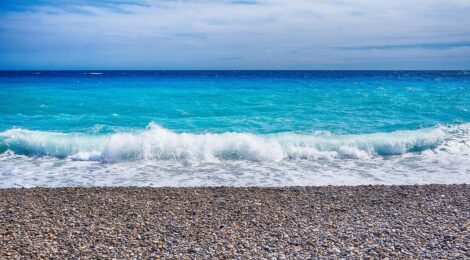
From the Old Town, every path seems to lead to the sea. The Promenade des Anglais stretches endlessly, a ribbon between water and sky. The sea here is not just blue; it shifts from glass-green to deep cobalt depending on the hour.
People move slowly along the promenade: runners, couples, old friends sitting in the blue chairs that face the horizon. There is a certain democracy in the way everyone shares this view, no hurry, no noise, just the sound of the waves and the occasional gull.
In the evening, the light turns gold. The sea mirrors the sky. The façades glow softly, as if painted by Matisse himself.
A City of Art and Air
Nice has always belonged to artists. The light is the reason, sharp yet forgiving, capable of revealing every shade of white and blue. In the quiet halls of the Matisse Museum, colour becomes language. A few streets away, Chagall’s stained glass glows like captured sunlight.
Even beyond its museums, the city itself feels like a living canvas. The Belle Époque façades, the pastel villas perched on hillsides, the faded signs on corner walls, everything carries traces of time and temperament.
Tastes of the Riviera
To understand Nice, you must taste it. The city’s food is honest, humble, deeply Mediterranean. Lunch might be a pan bagnat wrapped in paper, eaten by the beach, or a pissaladière still warm from the oven. Dinner stretches over hours, grilled fish, local wine, laughter under vines heavy with wisteria.
There is no rush here. Meals unfold the way the day does, gently, with pauses, as if to make more room for the air.
The Hills and the Horizon
Beyond the city, the hills rise in quiet contrast to the sea’s gleam. Èze, Villefranche-sur-Mer, Saint-Paul-de-Vence, each a short ride away, each its own universe of stone and silence. From the heights, you can look back at Nice, small and shining, the curve of its bay like a held breath.
It is easy to forget the rest of the world here.
The Memory of Light
When you leave Nice, whether by train, plane, or simply by thought, something lingers. Maybe it is the warmth that stays on your skin, or the way the light seemed to slow time. Nice does not ask for attention; it just imprints itself quietly, like sunlight through a shutter.
Long after you have gone, you will still see it when you close your eyes: that blue, that calm, that endless light that never fades.